Coinbase staking: Network Rewards, Commission, and Unstaking
updated
Coinbase staking lets eligible account holders earn proof-of-stake network rewards after Coinbase deducts its commission from those rewards. The deduction applies to earnings, while staking keeps the committed crypto subject to withdrawal conditions. Displayed reward rates already account for commission and summarize past payouts. A credited reward, an available trading balance, and a liquid staking token represent different states. Account eligibility and the selected staking method determine how rewards accumulate and when the assets can move.
Bottom line: The displayed retail staking APY already accounts for Coinbase’s commission, so subtracting that commission again would understate the net rate.
Reward Credits and Transferable Staking Positions
Account rewards add to a staked balance where reward restaking is permitted, while liquid staking tokens provide transferable exposure with separate conversion rates and market prices.
Hosted Account Balances
Account staking requires identity verification, an account in good standing, and residence in an eligible jurisdiction. Required tax identification and any local staking assessment also affect access. Asset-specific minimums and participation delays govern when rewards can begin. Coinbase or its validator operators perform the network operations on the account holder’s behalf. Reward credits appear in transaction history. Where restaking is permitted, they join the staked position and remain subject to the asset’s withdrawal conditions.
Liquid Staking Tokens
Eligible ETH and SOL positions can be wrapped into Coinbase Wrapped Staked ETH (cbETH) and Jito Staked SOL (JitoSOL), respectively. Availability depends on the region and supported asset. JitoSOL is unavailable in New York. Coinbase supports wrapping existing staked balances and a combined Stake & Wrap process for eligible unstaked holdings. These tokens allow transfers or sales while the underlying crypto remains staked.
Token quantities follow the applicable conversion rate, which accounts for the underlying staked asset and accrued rewards. Coinbase holds the ETH backing cbETH. The SOL underlying JitoSOL is staked through a third-party protocol and is outside Coinbase’s custody and control. Market prices can diverge from that underlying value, including trading at a discount. Selling or transferring a token passes its ownership and underlying claim to the recipient. Unwrapping returns the underlying staked asset; it does not complete the subsequent unstaking process.
Self-Custody and Coinbase Prime
ETH staking in the Base app uses a smart contract and a nontransferable cbwsETH token representing the position and withdrawal rights. Unstaking and the later claim require separate blockchain transactions and gas fees. This Base app method lists a 15% commission on ETH rewards, subject to change. Coinbase Prime has distinct vault-wallet requirements and staking approvals. Its Ethereum fee accounting covers distributed rewards and changes in pending rewards. The retail account commission and withdrawal instructions do not describe every staking service.
How Much Commission Comes Out of Network Rewards?
Coinbase deducts a percentage of earned network rewards, with the asset, region, and applicable subscription or promotion determining the retail staking commission. The published standard schedule lists 35% for ETH and SOL, although it does not apply in every region. Coinbase calculates this commission on earned rewards, leaving the staked principal outside its calculation base.
Asset and Plan Rates
Eligible Coinbase One members can receive reduced commission on certain assets, with any required opt-in completed. For ETH and SOL, the published rates are 31.75% for Basic, 28.5% for Preferred, and 25.25% for Premium. Account-specific promotions can also change the applicable rate. A smaller deduction leaves more of each network payout in the account. The subscription benefit changes Coinbase’s share of rewards without increasing the rewards that the network produces.
A Hypothetical Reward Credit
In this hypothetical case, an eligible account holds a supported staking asset and has a disclosed commission of 23%. The reader reviews the asset’s terms and confirms staking from the available balance. After participation begins, assume the network reward attributable to that stake totals 0.086 crypto units. Both the commission and reward amount are hypothetical inputs, not current account terms.
The commission equals 0.086 multiplied by 0.23, or 0.01978 units. Subtracting it leaves 0.06622 units for the reward credit before any asset-specific rounding. In the normal case, the account holder confirms the net payout in transaction history and checks it against the asset’s staking balance. The credited amount remains subject to unstaking conditions.
If the expected reward entry is absent, the calculation alone cannot establish receipt. Network participation and payout timing can lag staking confirmation. The asset’s payout schedule and account status determine whether an apparent delay needs further attention. An unresolved discrepancy requires account support; repeated staking submissions are not confirmation of a missing reward. Until the credit is recorded or the discrepancy is resolved, calculated earnings do not establish an available balance.
How Should You Read the Staking APY?
The account-staking annual percentage yield (APY) summarizes recent rewards after commission; it does not fix future payouts or token prices. Coinbase calculates the displayed staking APY from rewards paid over a recent trailing period. The calculation annualizes those rewards against the average amount staked, then incorporates compounding. New payouts gradually change the rate as they enter the calculation window. Networks set their own reward conditions. A higher displayed percentage does not prevent the token’s cash price from falling.
Auto-Staking for Future Purchases
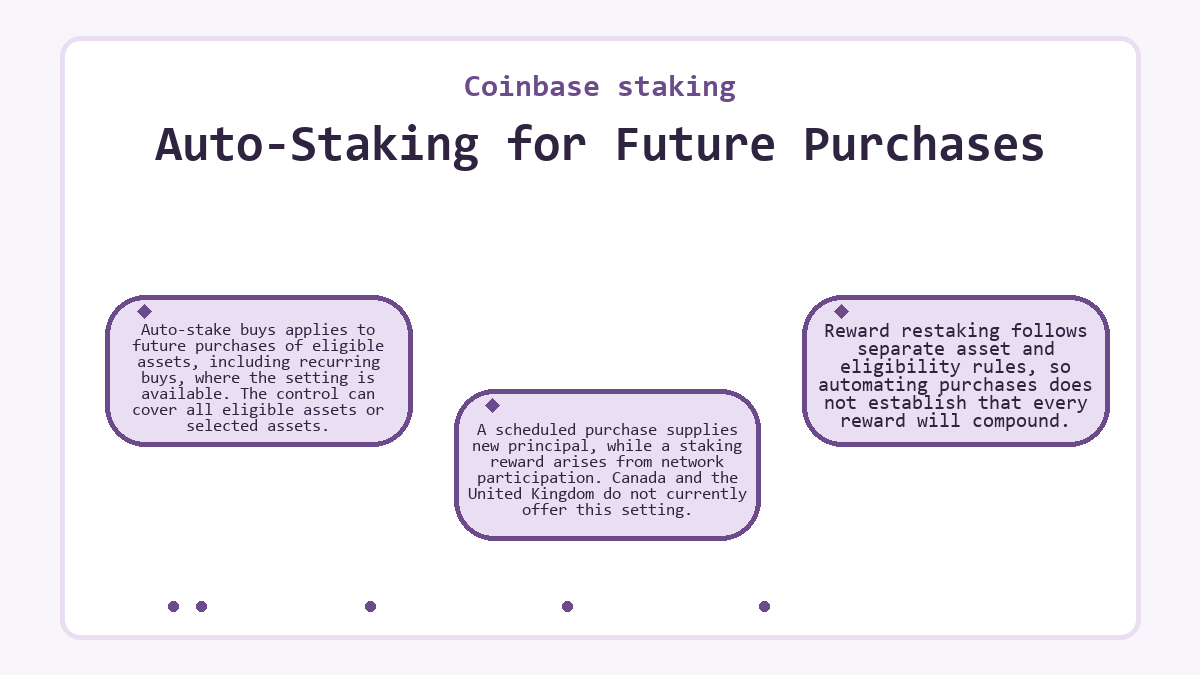
Auto-stake buys applies to future purchases of eligible assets, including recurring buys, where the setting is available. The control can cover all eligible assets or selected assets. A scheduled purchase supplies new principal, while a staking reward arises from network participation. Canada and the United Kingdom do not currently offer this setting. Reward restaking follows separate asset and eligibility rules, so automating purchases does not establish that every reward will compound.
How Can Staked Crypto Become Available for Trading?
A retail account’s staked balance becomes tradable after unstaking completes, through either the free standard route or an available instant route with a fee.
Standard Unstaking
Standard unstaking includes network waiting periods and Coinbase processing. The preview supplies an estimated wait, which can change with network conditions.
Ethereum standard unstaking has no guaranteed completion time. Crypto prices can move before the balance becomes available, even while an unstake request is pending.
Instant Unstaking
Instant unstaking credits the selected amount to the primary balance after deducting its fee, when the service is available. The charge applies only to the amount chosen for instant unstaking. An offered Skip Wait option can also convert selected pending standard requests. The transaction preview discloses the charge, and availability remains subject to limitations. A preview or pending request does not itself make the balance spendable.
Regional Restrictions and Protocol Penalties
Regional restrictions can allow existing stakes to earn rewards while prohibiting additional principal or reward restaking. Retail restrictions in California, Maryland, New Jersey, and Wisconsin bar new principal staking and reward restaking. The November 26, 2025 deprecation of Avalanche (AVAX) and Tezos (XTZ) staking for verified European Economic Area residents removed new staking for those assets. Existing stakes earn rewards during the notice period communicated to the account holder. After that period, remaining AVAX and XTZ stakes are unstaked and returned, with accrued rewards paid on the regular schedule. Once deprecation is complete, unstaked principal and rewards from these assets cannot be restaked in the EEA. A platform-wide asset listing does not establish an account’s eligibility to stake it.
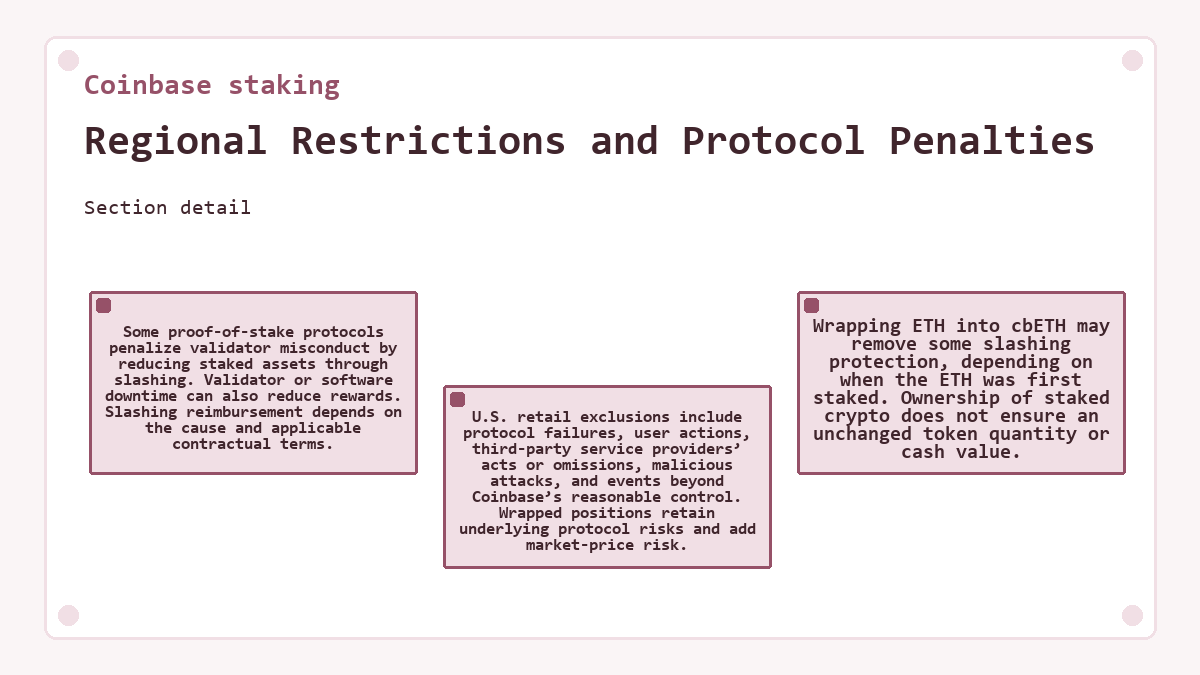
Some proof-of-stake protocols penalize validator misconduct by reducing staked assets through slashing. Validator or software downtime can also reduce rewards. Slashing reimbursement depends on the cause and applicable contractual terms. U.S. retail exclusions include protocol failures, user actions, third-party service providers’ acts or omissions, malicious attacks, and events beyond Coinbase’s reasonable control. Wrapped positions retain underlying protocol risks and add market-price risk. Wrapping ETH into cbETH may remove some slashing protection, depending on when the ETH was first staked. Ownership of staked crypto does not ensure an unchanged token quantity or cash value.
Practical questions about Coinbase staking
Do I Have to Stake All of My Eligible Crypto?
You can choose a custom amount instead of staking all available eligible assets. Coinbase’s staking controls include a Stake all option and an editable amount. The selected asset’s minimum still applies to the amount that you commit. Uncommitted crypto remains outside that stake, subject to ordinary account restrictions.
Can cbETH Acquired Elsewhere Be Unwrapped in a Coinbase Account?
Eligible cbETH held in a Coinbase account can be unwrapped even if it was acquired elsewhere. The account must be in good standing and eligible for ETH staking, with geographic restrictions also applying. Unwrapping requests may take time. The returned ETH remains staked until a separate unstaking request and the applicable unstaking process complete.
Is the all-time Staking Rewards Figure a Live Market Valuation?
The all-time rewards figure reflects the cash value of rewards when they were credited, rather than continuously repricing those earnings. The market value of the crypto that you still hold can subsequently rise or fall. A difference between the historical rewards figure and today’s holding value therefore does not, by itself, indicate a missing payout.
Can Rewards Accrue While a Standard Unstake Is Pending?
Rewards can continue during standard unstaking when the applicable asset’s network rules allow them. The protocol determines the earning period; a pending withdrawal alone does not establish the reward cutoff. Accrual and payout also occur on different schedules. Credited rewards that are restaked remain subject to unstaking conditions. Regional restrictions can prohibit restaking those rewards.
What Happens to Existing Stakes When Auto-stake Buys Is Disabled?
Disabling Auto-stake buys does not unstake crypto that is already staked. The setting controls automatic staking of future eligible purchases, including recurring purchases. Existing principal and accrued rewards remain governed by their staking terms. Making that balance available for trading or transfer requires the applicable unstaking process.
Do Retail Ethereum Staking Minimums Apply to Coinbase Prime?
Coinbase Prime applies its own validator and wallet minimums. Retail ETH staking has no minimum staking balance, whereas Prime’s initial validator activation requires 32 ETH. An existing active Pectra-upgraded 0x02 validator can accept top-ups of at least 1 ETH but less than 32 ETH, subject to remaining validator capacity. Deposits of 32 ETH or more create a new validator. Legacy 0x01 validators retain their 32 ETH requirement.